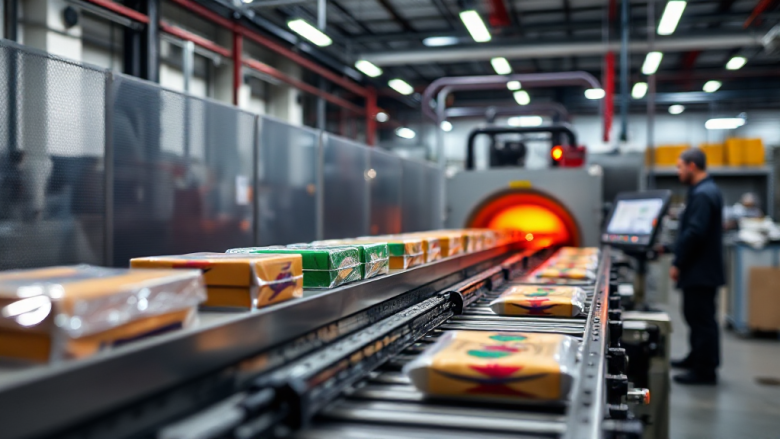
Energy and Waste in Automatic Shrink Wrapping Operations
Shrink tunnels are heat-hungry equipment, and small design choices change their footprint far more than most operators expect. A Shrink wrapping machine that runs well on paper can still waste power through open tunnel ends, oversized heaters, or film that is thicker than the pack actually needs. The good news is that most of these losses are fixable with better settings, maintenance, and machine selection rather than a full line replacement.
This article looks at shrink wrapping from a sustainability coordinator’s point of view: where the energy goes, how film choices affect waste, and what to measure before promising a reduction. It is written for production teams upgrading or auditing an existing packaging line.
Where the Energy Actually Goes in a Shrink Tunnel
A shrink tunnel is essentially a controlled hot-air oven. Heaters raise the air temperature, blowers push it across the pack, and the film shrinks around the product. Every time the tunnel is open at both ends, some of that hot air escapes into the plant instead of doing useful work. That escape is the first place to look.
Heating elements, blower motors, and the conveyor drive make up most of the electrical load. In many lines, the conveyor and blowers run continuously even when no packs are coming through. That idle draw adds up over a shift and is often invisible because no product is moving.
Heat recovery and tunnel insulation
Heat recovery on a shrink tunnel usually means capturing warm exhaust air and routing it back toward the tunnel inlet or using it to pre-warm incoming packs. It is not free: ducting, fans, and controls add cost and maintenance. But where a tunnel runs for long shifts, recovering even part of the exhaust heat reduces the heater duty cycle.
Insulation matters just as much. Poorly insulated tunnel walls and loose door curtains leak heat into the room, which then has to be removed by the plant’s cooling system. That is a double cost: you pay to heat the air and again to cool the space.
Idle and standby behavior
Ask whether the tunnel can drop to a standby temperature when the line pauses. Many automatic machines support this through the controller, but the setting is left disabled because it was never adjusted after commissioning. A short standby delay of a few minutes usually avoids nuisance reheating while still cutting idle energy.
Film Choices That Reduce Material Waste
Film is the second big lever. Shrink film comes in different thicknesses, widths, and resin types, and the cheapest roll is not always the least wasteful. A film that is too thin may tear and force rework; a film that is too thick uses more resin per pack and needs more heat to shrink.
Matching film width to the pack size reduces trim. On an automatic line, the sealing and cutting system determines how much film is used per pack, so a poorly set seal bar or a worn cutter creates scrap on every cycle.
Right-sizing the film to the product
Review the film gauge against the actual pack. Lightweight products often need less film than the line was originally set up for. A trial run comparing two gauges on the same product will show whether the thinner option holds up through handling and transport.
Recycled and recyclable film options
Recycled-content shrink film is available, but it can behave differently in the tunnel: it may shrink at a different rate or have different clarity. Test it on the actual machine before committing a full production run. Also check whether the local waste stream accepts the film type you choose, because a recyclable film that no one collects still ends up in landfill.
Cutting Scrap and Rework on the Line
Most film waste is not the film itself; it is the rework caused by bad seals, loose packs, and jams. A pack that comes out with a weak seal gets rewrapped, which doubles film use and tunnel time. Tracking rework rate is therefore a direct measure of material efficiency.
Seal quality depends on temperature, pressure, and dwell time. If any of these drift, waste rises quietly. A simple daily check of seal strength on a sample pack catches drift before it becomes a shift’s worth of scrap.
Maintenance as a waste-reduction tool
Worn cutters leave ragged film edges; dirty heaters run hotter to compensate; misaligned conveyors cause jams. Each of these produces scrap. A preventive maintenance schedule for the sealing and cutting assembly, the tunnel heaters, and the conveyor is one of the cheapest waste-reduction measures available.
Operator settings and training
Operators often adjust tunnel temperature and conveyor speed by feel. Written settings for each product, posted at the machine, reduce the trial-and-error that produces waste during changeovers. Training also helps operators spot a failing seal early instead of discovering it at the pallet.
Measuring and Improving the Footprint Over Time
You cannot manage what you do not measure. Start with three numbers: energy per shift, film used per thousand packs, and rework rate. These are simple to collect and together they show whether changes are working.
Energy per shift can come from a sub-meter on the packaging line. Film used per thousand packs comes from roll counts. Rework rate comes from the quality log. None of these require new software; a spreadsheet is enough to start.
Choosing equipment with efficiency in mind
When it is time to replace or add capacity, compare machines on more than speed. Ask about insulation, standby modes, heater control, and how easily the tunnel can be set for different film gauges. A well-matched shrink tunnel Machine sized to your actual throughput will usually use less energy than an oversized unit running at partial load.
For lines moving to higher volume, an Automatic Shrink Wrapping machine can reduce per-pack film waste through consistent sealing and cutting, provided the settings are tuned to the product. Automation helps most when the line is stable and the film is right-sized.
What to promise, and what to avoid
Be careful with broad claims. A packaging line change rarely delivers a fixed percentage saving across every product. Report what you measured, over what period, and under what conditions. That honesty protects the credibility of the whole sustainability program.
The most reliable gains usually come in this order: fix idle and standby settings, tighten seal and cutter maintenance, right-size the film, then consider heat recovery and equipment upgrades. Each step is verifiable, and each one compounds the next. Start with a walk around the tunnel at the end of a shift and look for heat escaping, film on the floor, and packs waiting for rework. Those three observations will tell you where the footprint is largest.