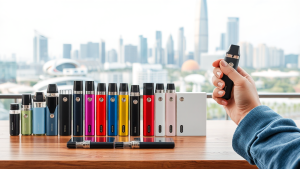
The Mechanics Behind Local Vape Ordering and Delivery
Most questions people ask about buying vapes online come down to a handful of moving parts. Once you understand three or four mechanics — how local stock works, how an order moves from cart to courier, how packaging is handled, and what same-day actually means in practice — most delivery questions answer themselves. You stop needing a specific answer for every scenario because you can reason about new situations on your own. That is the goal here: not a single recipe, but a working model of how Lana vape same day delivery fits together as a system.
Singapore is a small, dense market, and that density shapes everything. Distances are short, inventory can be held locally rather than shipped across borders per order, and a courier can realistically cross the island in an afternoon. Those three facts generate most of the behaviour you observe when ordering. The rest is process design — how a retailer decides what to stock, how it confirms an order, and how it gets a parcel into your hands without drama.
Local Stock Is the Engine Behind Same-Day Speed
The single most important mechanic is local inventory. A same-day promise is only credible if the item is already sitting in a warehouse or stockroom within the delivery zone. If a product has to be ordered from overseas after you check out, no amount of courier speed will save the timeline — customs, flights and handling add days, not hours. So when you see a genuine same-day offer, the real story is that someone decided in advance to hold that stock nearby.
This has consequences you can use. First, availability becomes the limiting factor, not distance. If a specific disposable model is in stock locally, it can reach you today; if it is not, the honest answer is that it cannot, regardless of how close you live to the warehouse. Second, product variety is a deliberate trade-off. Holding every possible variant ties up capital and shelf space, so retailers curate. That is why a local operation tends to carry a focused range — popular disposables, well-known pod systems, and the flavours that move — rather than an endless catalogue.
Third, local stock changes how you should think about timing. The question is rarely “how far away am I?” but “is the thing I want on the shelf right now, and is there still a delivery slot left today?” Those two conditions, not geography, decide whether your order arrives in the evening or tomorrow. Anyone browsing a Singapore lana vape catalogue is really browsing a snapshot of what is physically on hand at that moment.
How an Order Travels From Cart to Courier
The second mechanic is the order pipeline. It looks simple from the outside — you tap buy, something arrives — but there are distinct stages, and each one can add or remove time. Understanding the stages tells you where delays actually come from.
It starts with order capture: your cart is converted into a confirmed request, usually after payment clears. Then comes picking, where someone physically locates your item in the stockroom. Then packing, where the product is secured and prepared for transport. Then dispatch, where the parcel is handed to a rider with a route. Finally, last-mile delivery, where the rider navigates to your address.
Each stage has a natural bottleneck. Payment verification can stall if details do not match. Picking can stall if stock counts are slightly off. Packing can stall during a rush. Dispatch can stall if orders pile up faster than riders leave. Last-mile can stall on traffic, weather, or an address that is hard to find. When people ask why one order flew and another crawled, the answer is almost always that one of these stages was congested — not that the whole system is unreliable.
This is also why clear communication matters more than raw speed claims. A retailer that confirms your order, tells you it is packed, and gives you a realistic window is doing something more useful than promising the impossible. You can plan around a known pipeline; you cannot plan around a vague promise. For anyone comparing options, a Singapore vape delivery service that explains its stages is easier to trust than one that only advertises speed.
Discreet Packaging as a Process, Not a Promise
Discreet packaging is often treated as a marketing line, but it is really a set of physical decisions made at the packing station. The outer layer is plain and unremarkable — no branding that announces contents. The inner layer protects the product so it survives the trip. The label carries only what is needed to route the parcel. Nothing about the box telegraphs what is inside to a neighbour, a lobby, or anyone handling it along the way.
Why does this matter mechanically? Because it affects how the parcel moves. A low-profile package is easier to hand over at a door, easier to leave with a concierge, and less likely to attract attention in transit. It also means the recipient does not have to be present for a conspicuous delivery. The discretion is built into the same steps that handle logistics, which is why it costs nothing extra and does not slow anything down.
The practical consequence for you is simple: you can judge a delivery operation by how it talks about packing. If discretion is described as a default part of the process rather than a special request, it is probably baked into the workflow. If it sounds like an add-on, it probably is. A Vape delivery sg operation that treats plain packaging as standard is signalling that the packing stage is designed, not improvised.
What Same-Day Really Depends On
Same-day is not a single feature; it is the output of several conditions being true at once. Think of it as a checklist that must be satisfied before the promise holds.
First, the item must be in local stock. Second, your order must be placed before the day’s dispatch cut-off, because riders leave in batches and a late order misses the wave. Third, the delivery address must fall inside the served zone. Fourth, nothing unusual must happen — no payment mismatch, no stock discrepancy, no severe weather. When all four hold, same-day is routine. When one fails, the timeline stretches, and it is usually obvious which one failed.
This framing is useful because it lets you diagnose instead of guess. If you ordered early and the item was listed as available but nothing arrived, the likely culprit is either a stock count error or a routing issue. If you ordered late, you simply missed the dispatch wave. If you are outside the zone, no amount of urgency helps. None of these are mysteries once you know the conditions.
It also explains why a local shop model can be surprisingly effective. A Sg vape shop delivery setup that already holds physical stock in Singapore starts the day with the hardest condition — local availability — already satisfied. The remaining work is just disciplined execution: confirm, pick, pack, dispatch, deliver.
Reading Availability and Authenticity Signals
When you shop online, you are reading signals, and some are more informative than others. A product page that shows live stock status tells you something real about the local inventory mechanic. A page that lists well-known product lines — recognisable disposable models and pod systems — tells you the retailer is sourcing from established channels rather than unknown ones. Authenticity is not something you can verify from a web page alone, but the signals around it are readable.
Consistency is one such signal. If the same product names, specifications and flavour options appear reliably across listings, the catalogue is being maintained rather than scrambled together. Another signal is specificity: clear model names and capacities suggest the retailer knows its stock, which in turn suggests the stock is real and local. Vagueness, by contrast, often accompanies inventory that is not actually on hand.
There is also a timing signal. A retailer that holds local stock can answer availability questions quickly and concretely. One that dropships from far away tends to hedge. So when you are evaluating any lana vape sg listing, ask what it implies about the shelf behind it. The clearer the implication, the more likely the same-day mechanic will actually work for you.
Turning These Mechanics Into Good Decisions
Put the pieces together and a practical picture emerges. Local stock determines whether speed is even possible. The order pipeline determines where time is spent. Discreet packaging is a packing-stage decision that costs nothing and protects your privacy. Same-day is a conjunction of conditions, not a guarantee. And the signals on a product page tell you how seriously a retailer treats its own inventory.
With that model in hand, you can reason about situations nobody wrote a guide for. If a new flavour appears and you want it today, you check whether it is in local stock and whether you are before the cut-off. If a delivery is late, you can identify which stage likely stalled instead of assuming the worst. If you are choosing between retailers, you can compare how concretely each one talks about stock, packing and dispatch windows.
None of this requires memorising rules. It requires understanding a few mechanics and letting them do the work. A well-run local operation is essentially a system where each stage is designed to support the next, and the same-day outcome is simply what falls out when the design holds. Once you can see the system, the questions that used to need an answer become questions you can answer yourself.